
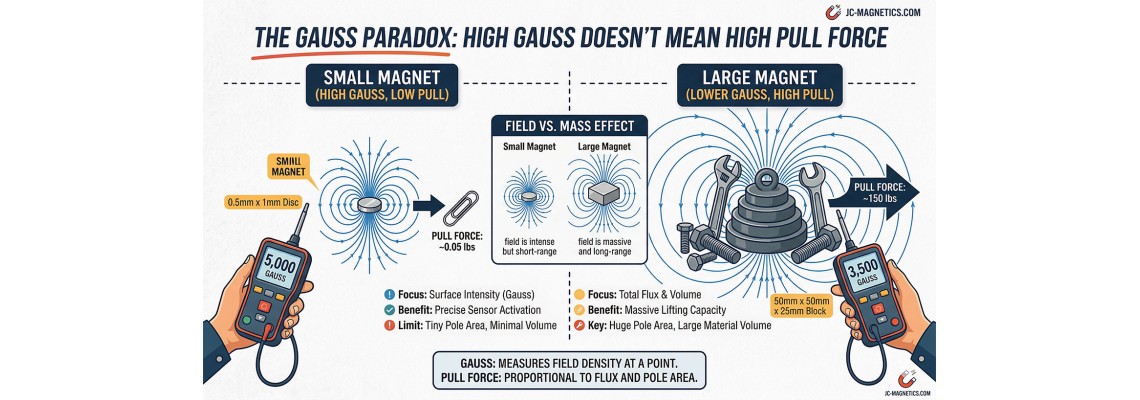
The Gauss Paradox: Why High Magnetic Field Strength Doesn't Always Mean More Pull Force?
The Core Argument: Gauss vs. Pull Force
To explain this to your customers, it is helpful to distinguish between Magnetic Flux Density (Gauss) and Magnetic Pull Force (Pounds/Kilograms).
1. What is Gauss?
Gauss measures the "density" of the magnetic field at a specific point (usually the surface). Think of it like pressure. A needle has high pressure at its tip, but that doesn't mean it can move a heavy object.
2. What is Pull Force?
Pull force is the total "work" the magnet can do. This depends not just on the intensity of the field, but on the total volume of magnetic material and the total flux being emitted.
The Science: Why Size Matters
The scientific justification lies in the Magnetic Flux. While a small magnet can have a very high surface Gauss rating, its magnetic field "reaches" out only a tiny distance.
The Comparison: Small vs. Large
The Small Magnet: A tiny Neodymium disc (e.g., 2mm x 1mm) might have a surface reading of 5,000 Gauss. However, because it has very little mass, its magnetic field lines close in on themselves very quickly. It might only have a pull force of 0.1 lbs.
The Large Magnet: A large Neodymium block (e.g., 50mm x 50mm x 25mm) might only have a surface reading of 3,500 Gauss. Despite the "lower" Gauss number, it has a massive volume of material. Its field lines extend much further into space, allowing it to "grab" onto steel from a distance. Its pull force could be over 200 lbs.
Scientific Key: Pull force is proportional to the square of the flux density multiplied by the pole area. A larger magnet has a much larger pole area, which exponentially increases its ability to hold weight, even if the Gauss "intensity" at a single point is lower.
Practical Takeaway for Your Customers
Choose Gauss if you are designing sensors (like Hall Effect sensors) where the intensity at a specific point is critical.
Choose Pull Force if you are looking to hold, lift, or secure objects.