
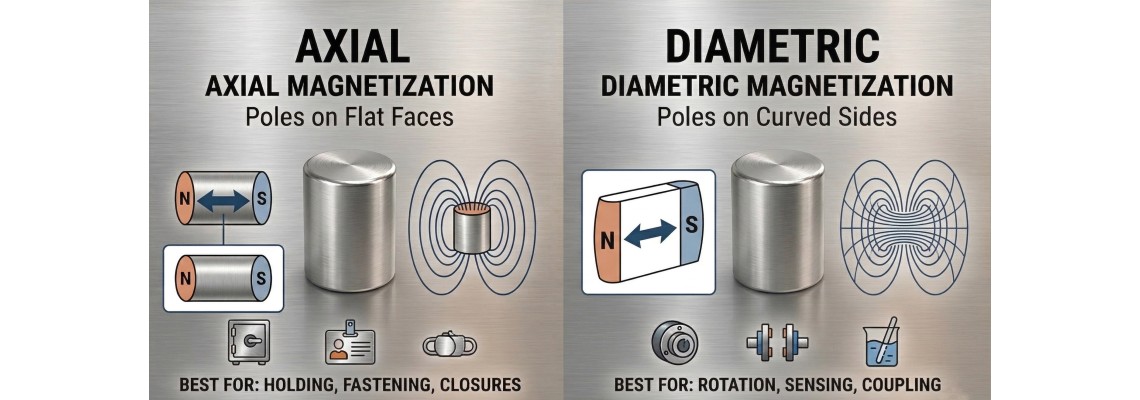
When sourcing neodymium magnets, the "strength" (or N-rating) is only half the story. The most critical factor for your application is often the direction of magnetization. While they might look identical on the outside, Axial and Diametric magnets behave very differently in a magnetic field.
1. Axial Magnetization
Axial magnets are the most common type. In these magnets, the poles are located on the flat surfaces. The magnetic field runs through the length (the axis) of the magnet.
How to identify: If you stack two disc magnets and they stick face-to-face, they are likely axially magnetized.
Best Applications: * Holding and Fastening: Perfect for cabinet latches, signage, or DIY magnetic tools.
Sensors: Used in reed switches where a vertical approach triggers the sensor.
Crafts: Ideal for jewelry clasps or 3D-printed closures.
The Advantage: They provide the maximum "pull force" when attached directly to a flat steel surface or another magnet.
2. Diametric Magnetization
In diametrically magnetized magnets, the poles are located on the curved sides. The magnetic field runs across the diameter of the cylinder or disc.
How to identify: If you place two cylinders side-by-side and they snap together along their lengths (like two logs rolling into each other), they are diametrically magnetized.
Best Applications: * Magnetic Couplings: Used to transmit torque through a wall without a physical shaft.
Rotary Encoders: Essential for Hall-effect sensors to detect rotation in motors or steering systems.
Magnetic Stirrers: Frequently used in laboratory equipment to spin a stir bar inside a beaker.
The Advantage: They are purpose-built for rotational movement. Because the poles are on the sides, they can create a "push-pull" effect as they rotate, which is impossible with axial magnets.
Comparison Table: Which One Do You Need?
| Feature | Axial Magnetization | Diametric Magnetization |
| Pole Location | Flat ends (Top/Bottom) | Curved sides (Left/Right) |
| Primary Use | Lifting, holding, sticking | Rotation, sensing, switching |
| Visual Hook | Stacks like a tower | Clumps like a bundle of logs |
| Common Shapes | Discs, Blocks, Rings | Rods, Cylinders, Discs |
Summary:
If you are building a display or a magnetic closure, Axial is your go-to. If you are designing a motor, a sensor, or a rotating mechanical device, Diametric is likely the solution you need.